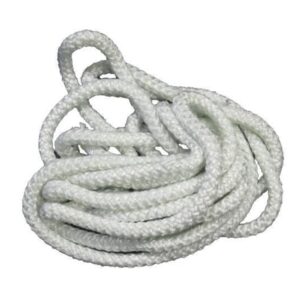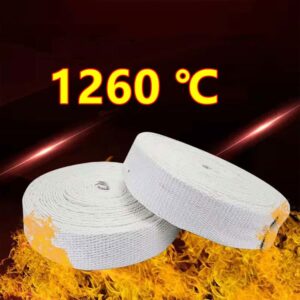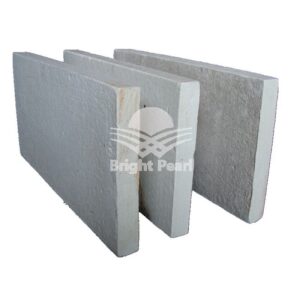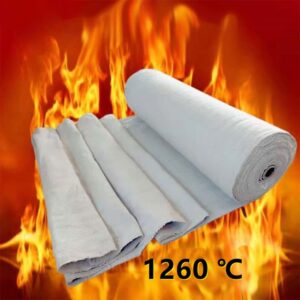
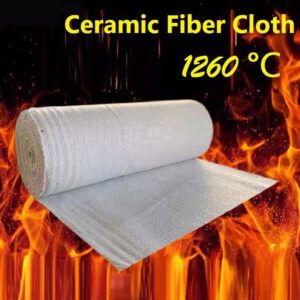
Manufacturers make ceramic fiber cloth by spinning ceramic fibers with some organic fibers and glass filaments into yarns. Then, they weave the yarns into cloth. The ablation rate depends on the amount of organic fibers. The type of organic fibers affects the cloth’s flexibility, in this order: viscose, polyester, pulp. The glass fiber thickness determines strength. The steel wire material affects corrosion resistance. This includes 304, 302, and 201 stainless steel wire and iron wire. Responsible firms choose fewer organic viscose fibers, thin glass fibers, and 304 stainless steel wires. The twist degree in weaving affects the cloth’s smoothness. The number of batches affects its density.
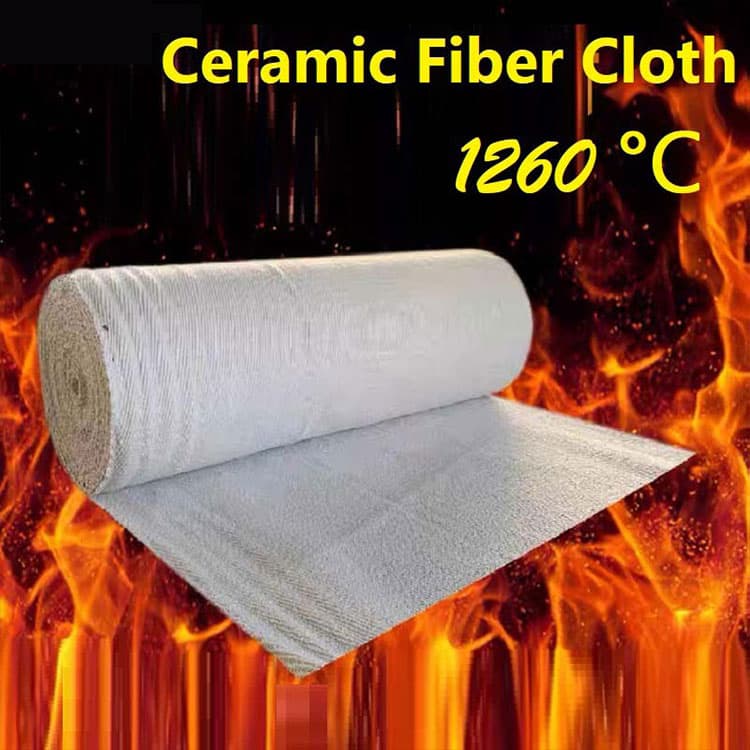
Ceramic fiber cloth has these traits:
1.It resists high temperatures.
2. It has low thermal conductivity.
3. Can withstand thermal shock and have a low heat capacity.
The general specifications and models of ceramic fiber cloth are 1.5 mm – 6 mm, with a general width of 1 mm.
We classify them into:
-
Nickel-chromium alloy wire is reinforced.
-
Stainless steel wire reinforced
-
Glass fiber-reinforced
-
Ceramic fiber-coated cloth
-
Ceramic fiber slag-catching cloth
-
Ceramic fiber-sintered cloth
-
Ceramic fiber fumigation cloth
The characteristics
High-temperature resistance, low thermal conductivity, thermal shock resistance, and low heat capacity.
Excellent high-temperature insulation performance and long service life.
Resistance to molten aluminum, zinc, and other non-ferrous metals.
Good low-temperature and high-temperature strength.
Non-toxic, harmless, and having no adverse impacts on the environment.
The application scope of ceramic fiber cloth includes:
Insulation and heat preservation for various furnaces, high-temperature pipelines, and containers.
Sealing materials for:
-
furnace doors
-
valves
-
flanges
-
fire doors
-
fire curtains
-
high-temperature furnace door curtains
Insulation and heat preservation for engines and instruments. Fireproof cable coverings. High-temperature fireproof materials.
Insulation cover fabrics, high-temperature expansion joint fillers, and flue linings.
Asbestos replacement products for high-temperature uses: sound absorption, fireproof suits, and filtration.
Advantages:
(1) The continuous service temperature can reach 1000℃. The short-term service temperature can reach 1260℃.
(2) It has good resistance to acid, alkali, and molten non-ferrous metals like aluminum and zinc.
(3) It has good high-temperature strength, insulation, and heat preservation. Please see the physical and chemical indicators.
(4) Alkali-free glass fibers reinforce ceramic fiber cloth, tape, and packing. They insulate better at high temperatures and electrically than glass fibers do.
(5) Non-toxic, harmless, and odorless.