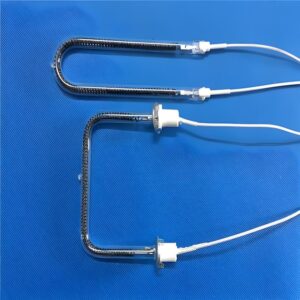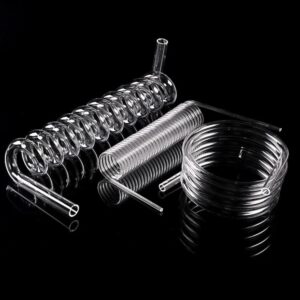
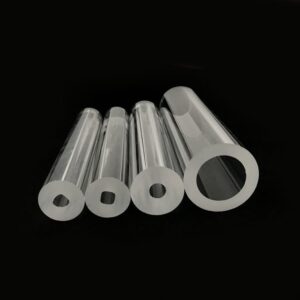
Chemical properties:
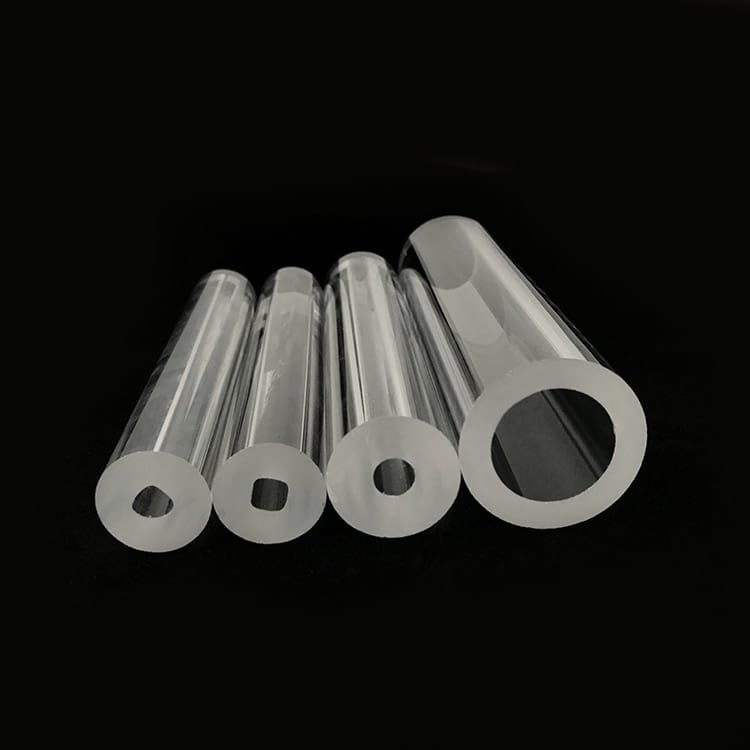
Quartz glass tube is an acidic material. It is inert to all acids, except hydrofluoric and hot phosphoric acids. Quartz glass tube is a very good acid-resistant material. It has better chemical stability than opaque quartz glass. It is non-hygroscopic and non-weathering.
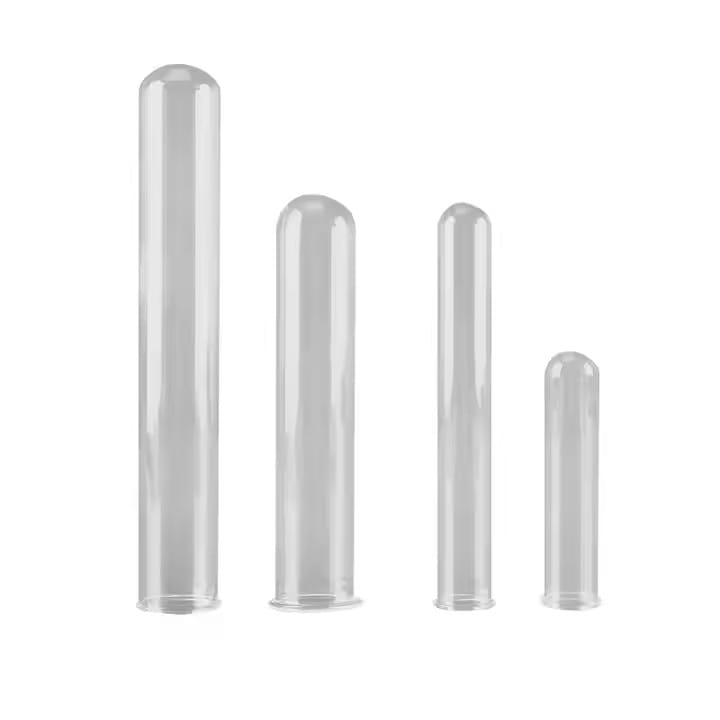 Electrical Properties:
Quartz glass tube has high dielectric strength and low conductivity. This holds at high temperatures, high pressure, and high frequency. It has high dielectric strength and resistance. It has almost no loss at the applied frequencies. So, quartz glass is an excellent high-temperature dielectric insulator.
Optical Performance:
Quartz glass tube has unique optical properties. It transmits both the far-ultraviolet spectrum and visible and near-infrared light. Quartz glass has high-temperature resistance, low thermal expansion, and good chemical stability. It has no bubbles or streaks, uniformity, and low birefringence. Its quality is comparable to that of general optical glass.
Thermal Properties:
The thermal expansion of quartz glass is small. It’s only one-twelfth to one-twentieth of ordinary glass. The standard says to burn the specimen to 1200 degrees Celsius. Then, you must plunge it into cold water repeatedly, more than three times. It must not explode.
Mechanical properties:
Quartz glass is stronger than coin glass and ceramics. But it is more brittle. The theoretical strength of quartz glass is very high, about 24 * 1.3 MPA. But, the actual measured strength is tens of times lower.
Airtight performance:
Quartz has a relaxed structure, even at high temperatures. It lets some gases diffuse through its network. Sodium ions diffuse the fastest. This property of quartz glass is particularly important for users.